
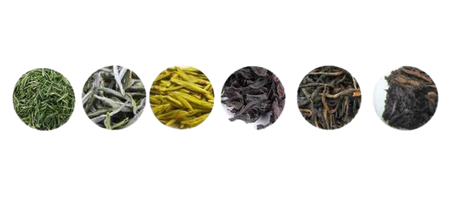
Many people assume “tea” only refers to leaves picked from the tea plant. But in Chinese daily language, “tea” is often used in a broader sense: as long as something is infused in hot water, it may be called “XX tea.” For example, jasmine flowers infused in water can be called “jasmine tea,” and sanqi flower infusion may also be called “sanqi flower tea.” In English, drinks like these are usually described as herbal tea (some people also say herbal infusion / tisane).
When we talk about green tea, white tea, oolong, black tea, and dark tea in the context of tea classification, we’re usually talking about true tea—tea made from the leaves of Camellia sinensis—and how different processing methods create different styles.
This guide follows that logic:
first, the two meanings of “tea,” then the six major tea types, and finally “sheng/shou” in the Pu-erh context.
01 The Six Major Tea Types: “Green vs Black” Is About Processing, Not Leaf Color
In China, tea is commonly grouped by processing and degree of oxidation. Here, “oxidation” means natural chemical changes in the leaf driven by enzymes and oxygen. In everyday tea talk, people sometimes call this “fermentation,” but it’s not always microbial fermentation in the strict sense.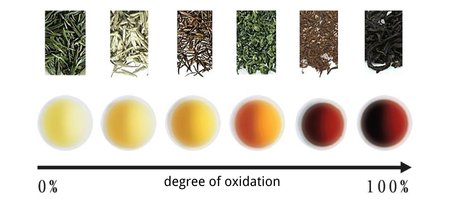
Green Tea (Non-oxidized)
Key step: fixation (sha qing / “kill-green”)—heat is used to deactivate enzymes quickly, preventing oxidation and preserving a fresher, brighter profile.
Examples: Longjing (Dragon Well), Biluochun.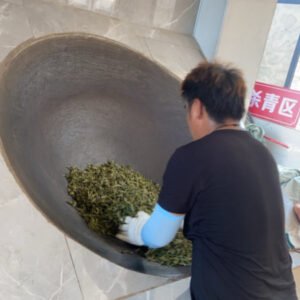
White Tea (Lightly oxidized)
A more minimal-intervention style, mainly withering + drying. Gentle, slow oxidation creates a light, delicate character.
Examples: Silver Needle, White Peony, Shoumei.
Yellow Tea (Lightly oxidized)
Similar to green tea but with an added “yellowing” (men huang) step, producing a smoother taste and the classic “yellow liquor, yellow leaf” impression.
Example: Junshan Yinzhen.
Oolong Tea (Semi-oxidized)
Complex processing; the core is bruise-and-oxidize (zuo qing)—shaking and resting encourage oxidation along the leaf edges while the center stays greener, creating layered aromas and depth.
Examples: Tieguanyin, Dahongpao, Dancong.
Black Tea (Fully oxidized)
Key is full enzymatic oxidation, often resulting in a sweeter, richer, rounder cup with a reddish liquor.
Important note: Chinese “hong cha” (literally “red tea”) is called “black tea” in English, because early Western naming focused on the darker color of the dry leaves.
Dark Tea / Hei Cha (Post-fermented)
Typically involves post-fermentation, often with microbial participation (e.g., a piling process such as wo dui), leading to deeper color, a mellow mouthfeel, and aged aromas.
Examples: Anhua dark tea, Liubao tea.
(To avoid confusion: in English, Chinese “hei cha” is often translated as dark tea or post-fermented tea.)
02 Sheng and Shou: A Pu-erh-Specific Split (Not an Extra “Seventh Category”)
“Sheng” and “shou” are most commonly used in Pu-erh tea. They aren’t a separate tea class outside the six types—rather, they describe two different transformation paths within Pu-erh.
Sheng Pu-erh (Raw Pu-erh)
Made from sun-dried Yunnan large-leaf material (mao cha) without artificial piling. When young, it tends to feel brighter and more assertive; with storage, it gradually becomes rounder through slow oxidation and ongoing transformation—often referred to as aging.
Shou Pu-erh (Ripe Pu-erh)
Uses a controlled wo dui (piling) process to accelerate transformation, producing a mellower, smoother style with more developed aged notes—ready to drink sooner.
From the “six tea types” perspective, shou Pu-erh is often discussed within the broader frame of dark tea (post-fermented tea).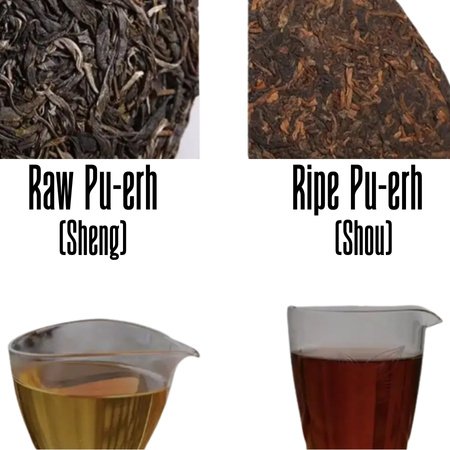
03 How to Use This Without Getting Confused: Focus on “Plant Source” + “Processing”
- If it’s made from tea plant leaves (Camellia sinensis), it usually fits into the six major types (green / white / yellow / oolong / black / dark).
- If it’s made from flowers, leaves, roots, or fruits that are infused for drinking, Chinese may still call it “XX tea,” and English commonly calls it herbal tea.
- If you see sheng/shou, think Pu-erh’s two routes, with the key question being whether there is wo dui (piling) or not.